
Read our buying guides and make the right choice

Choosing the right industrial casters
Mounted on loading equipment such as trolleys or platforms, industrial casters and wheels facilitate the movement of loads (people, machines, pallets, parts, etc.) from one place to another.
There are several types of casters (fixed or swivel), made of different materials and available in different sizes. Generally speaking, the wheels contain elements made of plastic, metal, rubber and polyurethane.
All industrial sectors use equipment mounted on casters, for example for order picking or moving parts on a production line.
View Industrial Casters
How to choose casters?
To choose the right casters, you will need to determine:
- the weight of your load: to find out the load capacity for using casters safely, add 30% to the total weight of your load and divide by 3. If there is a risk of your load falling while moving, use a factor of 300% instead of 30%
- the speed at which your rolling equipment will have to operate: the rolling time at a given speed must also be taken into account. Always plan for the maximum speed, maximum load and maximum time for safe use of your casters
- The type of surface the casters will roll over: is it wet, dry, made of concrete, etc.? Also check the floor for flaws
- the environment : you must determine whether the trolley will be used indoors (ambient temperature), outdoors (high or low temperatures) and whether there is a risk of humidity or explosion.

TENTE swivel casters
Will you need fixed or swivel casters?
Swivel casters are designed to rotate 360°. They are mounted on a fork that swivels, allowing them to turn in any direction. They are available with or without brakes. The advantage to this type of casters is that their design allows the load to be moved in the desired direction. However, at high speeds, these casters are less stable and consequently so is their load.
Fixed casters are mounted on a fixed fork and can therefore only move in a straight line. Their greatest advantage is that they offer a high degree of steering stability compared to swivel casters, especially when they gain speed.

Blickle Räder+Rollen fixed casters
How should you position the casters?
Several wheel configurations are possible, combining fixed and swivel casters. This table presents the main configurations and their advantages.
| TYPE OF CONFIGURATION | CHARACTERISTICS | ADVANTAGES |
|---|---|---|
| 2 swivel 2 fixed | Most frequent layout For heavy loads For long distances | Affordable More stable in a straight line |
| 4 fixed | Light loads Not recommended for use on ramps | Economic positioning |
| 4 swivel | For applications requiring lateral movement | Flexible layout |
| 2 swivel 2 fixed (diamond pattern) | Not recommended for use on ramps | Easy to handle |
| 4 swivel 2 fixed | For very heavy loads For long travel times | The 2 fixed casters allow the weight of the load to be distributed over the 4 swivel ones |
What type of tread should you choose?
The tread is the material of the wheel that is in contact with the ground. It impacts the quality of the wheels, as does the type of bearing.
You will mainly find:
- rubber casters semi-elastic solid rubber, synthetic rubber and
- shock and vibration absorption
- casters with pneumatic tyre
- The choice of material depends on different criteria:
- maximum load (load weight and equipment weight)
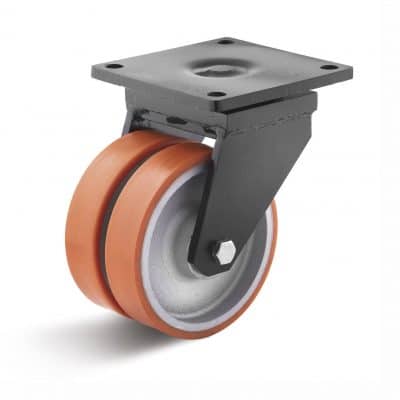
TORWEGGE polyurethane casters
The table below describes the types of treads and their main characteristics.
| TYPE OF TREAD | LOAD CAPACITY | HANDLING | PUSHING FORCE | USER COMFORT | SHOCK ABSORPTION |
|---|---|---|---|---|---|
| Semi-elastic solid rubber | Good | Very good on uneven floors Medium oil resistance | Low | Very good Very quiet | Very good |
| Semi-elastic solid rubber | Good | Very good on uneven floors Medium oil resistance | Low | Very good Very quiet | Very good |
| Semi-elastic solid rubber | Good | Very good on uneven floors Medium oil resistance | Low | Very good Very quiet | Very good |
What type of bearings should you choose?
Several types of anti-friction bearings are available, we have selected three for you.
Slide bearings or plain bearings
- This is the simplest type of bearing.
- They are made of polyamide and require no maintenance. They are also shock and corrosion resistant.
- Slide bearings are suitable for handling equipment that is not intended to be moved frequently.
- They are made of two rings between which hardened steel balls roll.
- They are used in pairs.
- They can only support radial loads.
- They offer good rolling properties for high loads and at high speeds.
Roller bearings
- These are the most common bearings used in industry.
- They do not consist of balls but of rollers housed in a cage.
- You should favor this type of bearing if you have heavy loads to transport over a long period of time.
- They are resistant and require little maintenance.

SUGATSUNE KOGYO ball bearing casters
RELATED GUIDES

Choosing the right pressure sensor
- Why choose a differential pressure sensor?
- Why choose a differential pressure sensor?
- Why choose a differential pressure sensor?

Choosing the right pressure sensor
- Why choose a differential pressure sensor?
- Why choose a differential pressure sensor?
- Why choose a differential pressure sensor?
Choosing the right pressure sensor
- Why choose a differential pressure sensor?
- Why choose a differential pressure sensor?
- Why choose a differential pressure sensor?
Choosing the right pressure sensor
- Why choose a differential pressure sensor?
- Why choose a differential pressure sensor?
- Why choose a differential pressure sensor?
3 COMMENTS
Eli Richardson
14 April 2021at 6:58 pm
It’s great that you talked about different types of industrial caster’s materials. In my opinion, it’s a good idea to look for different options when choosing a product for your company. In that way, I think you could select the one that better fits your customer’s needs. Thanks for the tips on how to pick casters for your business’s needs.
Eli Richardson
14 April 2021at 6:58 pm
It’s great that you talked about different types of industrial caster’s materials. In my opinion, it’s a good idea to look for different options when choosing a product for your company. In that way, I think you could select the one that better fits your customer’s needs. Thanks for the tips on how to pick casters for your business’s needs.
Eli Richardson
14 April 2021at 6:58 pm
It’s great that you talked about different types of industrial caster’s materials. In my opinion, it’s a good idea to look for different options when choosing a product for your company. In that way, I think you could select the one that better fits your customer’s needs. Thanks for the tips on how to pick casters for your business’s needs.
Leave a Reply
Your email address will not be published. Required fields are marked *